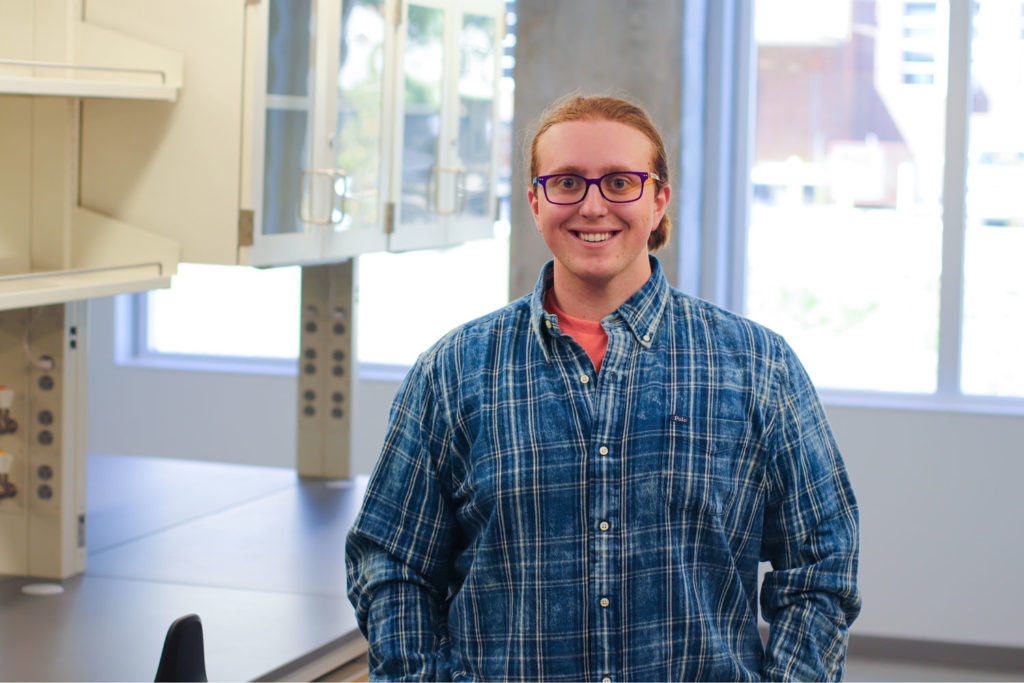
A neutron strikes a uranium atom, turning it into medical asset. A senior design project strikes inspiration into a biomedical student, turning him into a nuclear engineer.
Though he graduated from UT in Spring 2022 as a Biomedical Engineering (BME) major, Caleb Noe is currently in his first semester as a master’s student in Nuclear Engineering (NE).
“I wanted to be a doctor like my uncle, so I started with BME,” said Noe. “But by senior year, I thought maybe I should look into something else.”
That’s when he received an email advertising the Interdisciplinary Senior Design (ISD) course.
“I thought, ‘This will be a good chance to work with other disciplines. It will broaden my views,’” Noe said.
“It’s an invaluable experience,” said Keith Stanfill, Edwards Assistant Dean and Director of Integrated Engineering Design at UT. “In an ISD, Tickle and Haslam College seniors learn to write and speak at a professional level, collaborate across other disciplines, and work under the guidance of expert faculty and industry mentors.”
Seniors in ISD hear from faculty ‘coaches’ about available projects from external agencies, then apply to work on their top choices.
“We want to solve authentic, business-relevant technical challenges for sponsoring companies,” said Stanfill. “Those projects that seem to always be left on the board at the end of business meetings are prime targets for ISD.”
The project that appealed most to Noe was coached by Eastman Professor of Practice Sankar Raghavan. United Cleanup Oak Ridge (UCOR) LLC had reached out to Raghavan regarding decommissioned equipment that had filled with radioactive uranium gas. UCOR wanted UT seniors to find the best way to recover and use the high-energy atoms.
Raghavan had advertised spaces for four engineering disciplines. BME wasn’t on the list.
“Dr. Stanfill and I usually brainstorm the kinds of skills that will be required in the project, then use that understanding to recommend majors,” said Raghavan. “But some students are particularly excited about some proposal.”
“I knew it would be a huge learning process,” Noe said, “but I also thought it would be fun.”
Seeing Noe’s enthusiasm, Raghavan had no problem putting him on the UCOR project.
“It was a great team,” said Noe. “Everyone shared their expertise. You start learning things from other people’s experiences—their classes, their internships. Things that weren’t covered in classes for your major.”
Noe’s own background ultimately took the project in an unexpected direction.
“As a biomedical student, I was able to see that this waste could be turned into nuclear medicine,” said Noe, explaining that radioactive uranium can give rise to a type of thorium that is very useful in treating some cancers.
“I was pleasantly surprised that Caleb found that solution,” said Raghavan. “That was a big contribution and helped a lot with the team’s overall performance.”
As the project progressed, Noe started thinking seriously about a career in nuclear engineering. “I could see myself doing this for a long time,” he said. UCOR shared that vision, hiring him for a summer internship after he graduated.
Halfway through the internship, Noe officially requested that his master’s enrollment at UT be changed from BME to NE.
“There are basic nuclear things I’m going to struggle with at first, but it will be fine,” said Noe. “It’s already been very rewarding.”
Stanfill said such a move was not a surprise.
“It is not at all unusual for students to change focus following an ISD,” Stanfill said. “Sometimes students discover something new that they are passionate about.”
For Raghavan, it is just one factor that makes such projects worthwhile.
“The ISD projects have impacted the career choices of about 25 percent of the students I have coached,” said Raghavan. “That’s gratifying to me, and it also says something about the ISD program. It’s a lot of work, but it’s worth it.”
Contact
Izzie Gall (865-974-7203, [email protected])