Many Hands Make Light Work
Inside nuclear reactors is an environment of extremes, from corrosive coolants to the bombardment from high-energy neutrons and temperatures usually only seen on the surface of stars. Reactor materials are carefully built to withstand those incredible stresses for decades on end. But how can you make sure that they do?
“The central problem of radiation material science is that you have processes that start at the atomic scale and last picoseconds (trillionths of a second) that have consequences over meters of materials and timescales of 30 years,” said Alexis Devitre, a research assistant professor in the University of Tennessee-Oak Ridge Innovation Institute’s (UT-ORII) Fusion Technology and Materials for Extreme Environments Convergent Research Initiative. “We want to be able to continuously test a piece of material evolving in a reactor environment.”
Devitre has been working to integrate transient grating spectroscopy (TGS) into UT’s Tennessee Ion Beam Materials Laboratory (TIBML). TGS is an automated laser evaluation technique that could one day be used to check on the integrity of materials inside a reactor in situ (while the reactor is running).
The TGS effort includes other researchers from multiple disciplines at both UT and ORNL, including TIBML Director and Department of Nuclear Engineering Associate Professor Khalid Hattar, Department of Materials Science and Engineering (MSE) Professor Philip Rack, and graduate and undergraduate students.
Once completed, the TGS will improve UT’s material characterization capabilities and integrate with ATHENA, the university’s federally funded research hub devoted to automating material characterization.
After that, the team hopes to standardize and improve the TGS into an everyday diagnostic test capable of evaluating nuclear facility integrity at any time, anywhere in the world.
“In situ techniques are a big deal—you don’t have to power down your reactor or pull any parts to check (on the materials),” said Ewan McCombs, an MSE junior who has had a significant role in getting UT’s TGS up and running. “(It is also) very useful from a safety standpoint, because you don’t have to have any people exposed to radiation to go in and retrieve pieces.”
Building a Laser Ripple Machine
Originally developed for fundamental physics research, TGS fires brief laser pulses onto a material surface, creating a periodic heating pattern that generates a ripple on the material’s surface as small as 100 microns (100 millionths of a meter) in diameter.
A separate probe laser measures the ripple’s decay, letting scientists evaluate the material’s thermoelastic performance and offering insights on which stressors are causing damage.
In the 2010s, Hattar and Massachusetts Institute of Technology (MIT) Professor Michael Short—one of Devitre’s PhD advisors—constructed the world’s first beamline-coupled TGS at Sandia National Laboratories in New Mexico.


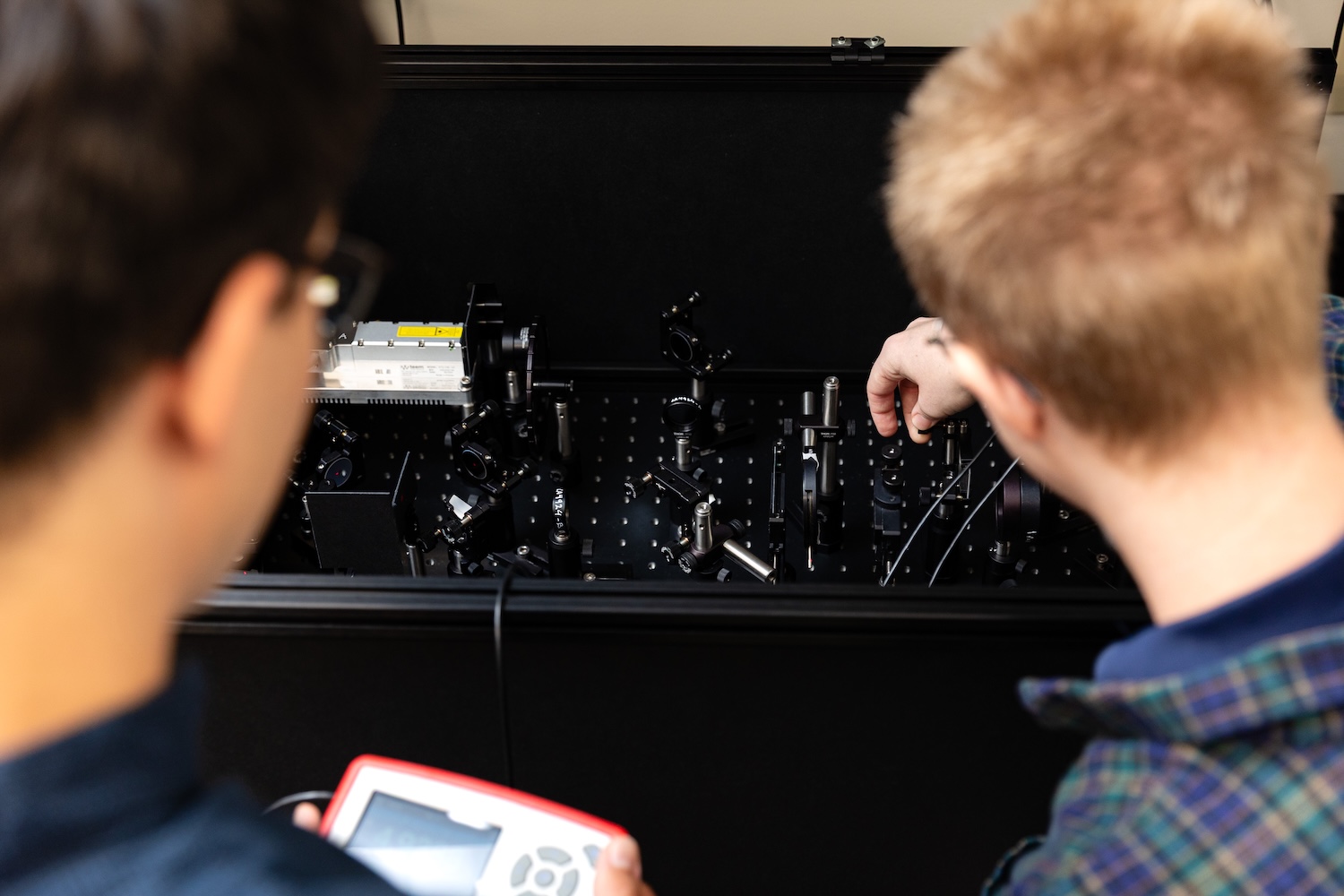
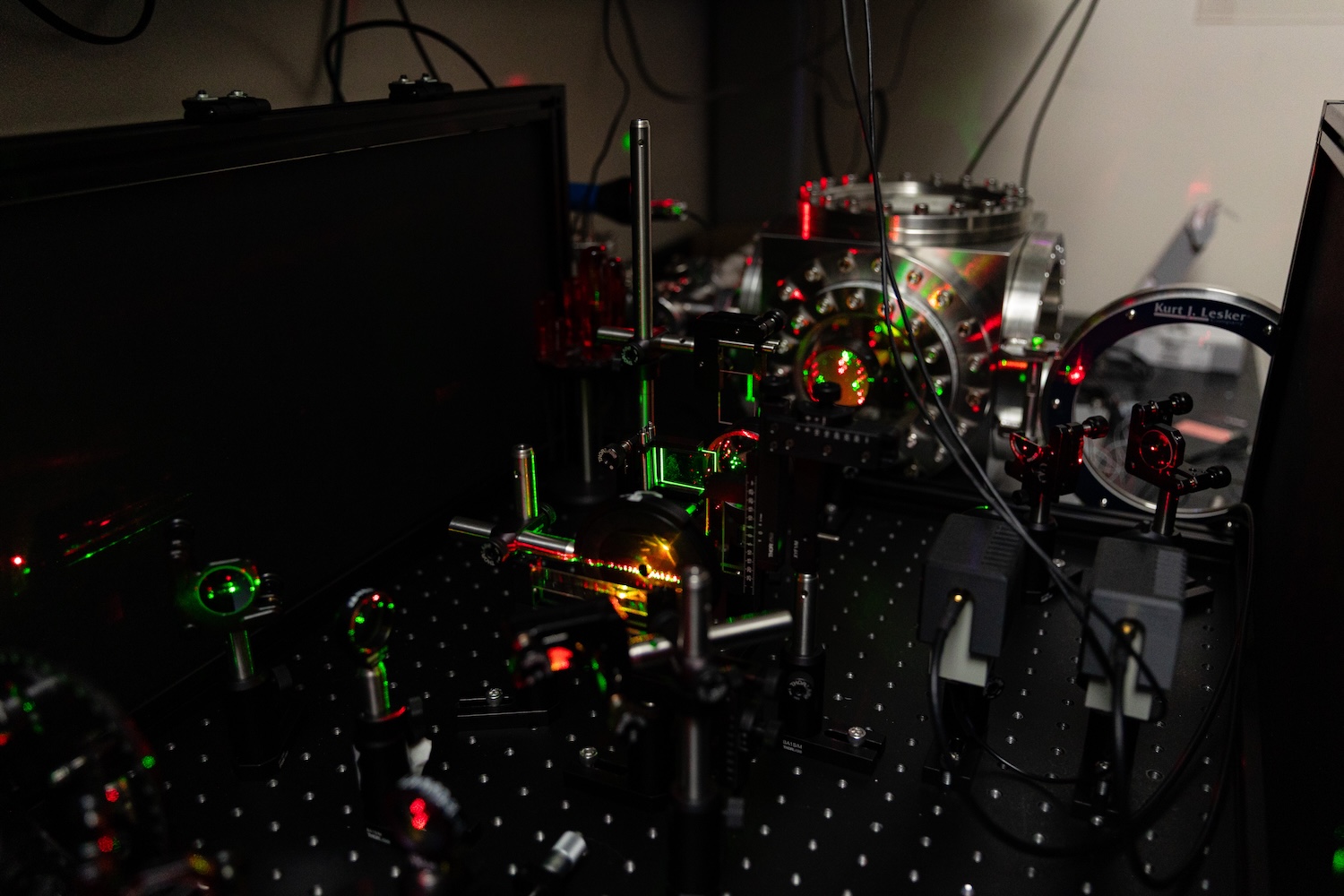
Fifteen years later, a few beamline TGSs are scattered around the world—but each system still has to be made from scratch, using dozens of optical components aligned so precisely that six lasers hit the same 100-micron spot.
McCombs and Devitre’s first six months on the project involved a lot of phone calls with other TGS builders around the world, relying on both their advice and moral support. McCombs was happy to return the favor by sharing perspective and insights from his MSE coursework.
“There’s so much merit to interdisciplinary work,” he said. “I have a different education than a lot of the physics or nuclear (engineering) people that I work with, so we’re learning from each other. I think (it) is beneficial for undergraduates to feel like they can contribute to the conversation.”
Expanding TGS Capabilities
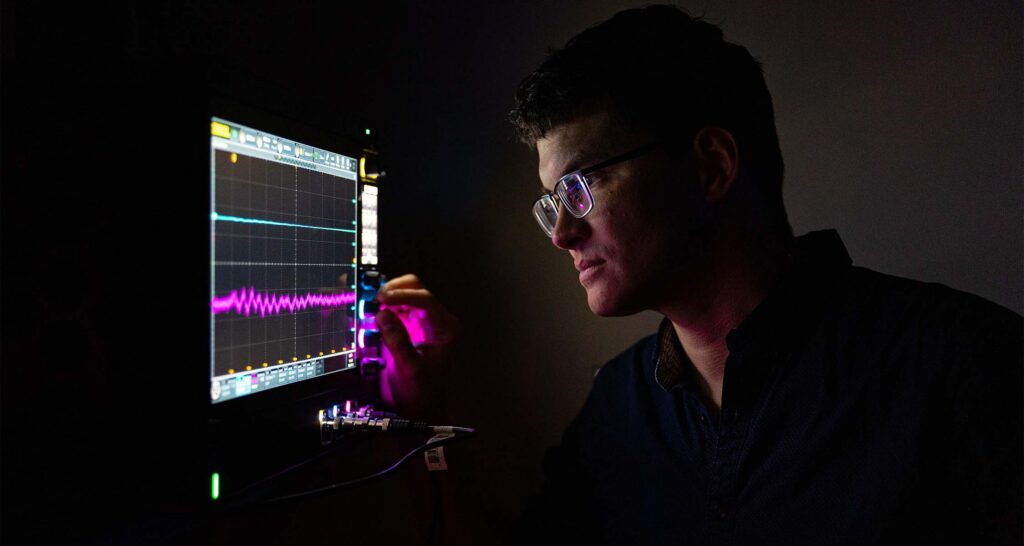
The team’s hard work paid off in the summer of 2026, when McCombs achieved UT’s first ever TGS readings.
“We already have a lot of people knocking on the door, like, ‘Can we do a quick measurement? Can we try it on our material?’” Devitre said.
However, the system is still a few steps away from beamline integration. McCombs’ next goal is to evaluate how TGS readings vary depending on the local structure within the 100-micron spot where readings are taken.
“When evaluating reactor components in service, it is important to understand how different factors like surface quality or grain boundaries affect the measured signals and when a given data set can be representative of the overall material,” he explained. “I’m very excited for doing collaborative work with other people’s samples and getting other people interested in this technique because it shows a lot of promise.”
Devitre is immensely proud of McCombs and all the other students and researchers who have contributed to the TGS system.
“There have been many people involved in this effort, and hopefully (there will be) many more,” Devitre said. “What we’ve built at this point is not new, but there’s so much more we can do with it.”
Contact
Izzie Gall ([email protected])