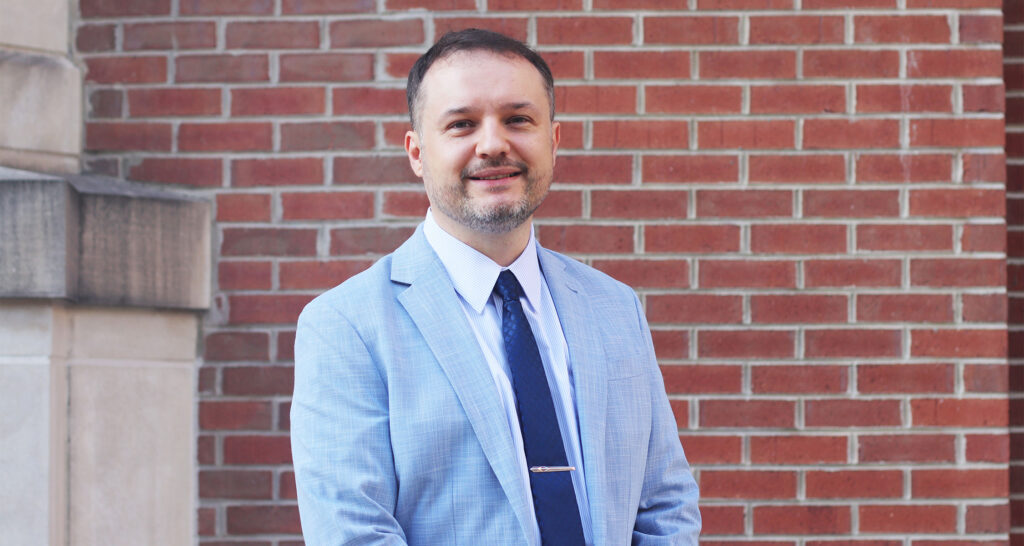
Associate Professor Popovs Brings Molecular Engineering Background to NE
Ilja Popovs will join the University of Tennessee’s Department of Nuclear Engineering as a tenure-track associate professor on August 1—after wrapping up his research in the Nanomaterials Chemistry Group at Oak Ridge National Laboratory (ORNL).
“I received my PhD in organic chemistry and am becoming a nuclear engineering professor, so one might wonder, ‘How did this come together?’” Popovs said. “The academic journey that I took is fairly non-typical for a radiochemist.”
Popovs conducted his doctoral studies at the University of Houston, focusing on supramolecular chemistry, which investigates how molecules bind to each other to form larger systems. Popovs was particularly interested in engineering catalysts, molecules that enable or speed up chemical reactions. Catalyst engineers transform small, relatively simple molecules that can accomplish a simple task into significantly more complex systems that perform new, or multiple, functions.
During his postdoctoral fellowships at Northwestern University and ORNL, Popovs realized that his expertise in molecular design could be applied to a much broader problem space.
“I began to appreciate the types of problems that could be solved with supramolecular chemistry and material science, and the types of things that can be enabled by having skills in such a diverse field,” he said.
Research Plans at UT
One of the new uses for supramolecular chemistry that intrigues Popovs is synthesizing chelators, or molecules that attract and hold onto metal ions. During his five years at ORNL, he has been deeply involved in developing new separation and isolation procedures and technology for radioisotopes.
In his lab at UT, Popovs plans to create effective chelators for lanthanides and actinides. Popovs believes he can harness these important radioisotopes from environments where they currently cannot be used—or are even considered contaminants.
“These are valuable materials that can enhance the production of nuclear energy, and we could extract them from production streams, mine tailings, or possibly even spent nuclear fuel,” he said. “I will be very interested in harnessing the high-priority radioisotopes from sources which we don’t currently have the technology to tap.”
Popovs will also focus on synthesizing chelators that can apply abundant but underutilized radioisotopes to medicine. He is particularly interested in radium-223, which is currently used to relieve pain in patients whose advanced cancer has metastasized to their bones.
Currently, radium-223 ions diffuse equally to all bone cells experiencing fast turnover. That generalized spread makes it inadvisable to use the radioisotope except in palliative care (making a patient with terminal illness more comfortable).
However, Popovs believes he can create an effective chelator that keeps radium-223 localized to tumors, expanding its use into cancer treatment.
“If one could develop such a technology,” he said, “it would be a very powerful and straightforward way to expand the palette of available radioisotopes, and the types of treatments available to patients.”
Teaching at UT
While Popovs is fully confident in his technical skills and research direction, the teaching aspect of his new role is a novel challenge he looks forward to tackling.
“I am extremely excited about working much closer with, teaching, and mentoring the next generation of scientists and engineers,” he said. “I am looking forward to harnessing the passion and creativity that is laying dormant within the class of 2029.”
Popovs knows that his new colleagues will help him find his footing in both the lab and the classroom.
“Being at the cutting edge of both research and teaching is obviously challenging, so I feel very fortunate to be joining a department that is known for its mentoring and teaching as well as its research,” he said. “All of the colleagues were outstanding in welcoming me to the department. I’m extremely excited about the opportunity to work with them and learn from them. I feel that even if something unforeseen arises, I will have a very strong base of support to fall back on.”
Contact
Izzie Gall (865-974-7203, [email protected])